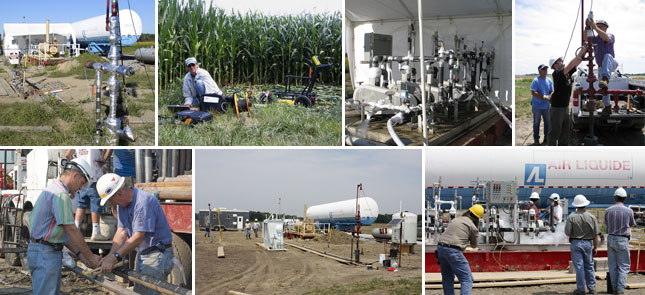
Coalbed methane
Coal injection pilot — Tanquary Field
The coal seam injection test was designed to determine the CO2 storage capacity, injection rate, and the ECBM recovery potential of Illinois Basin coal. Numerical modeling will be used to assess ECBM and sequestration at large scale and update Phase I CO storage resource estimates.
The pilot's injection formation was the Springfield coal, high volatile bituminous rank, thickness 7 ft, depth 900 ft, desorbed gas content ranged 150–210 cf/ton (dmmf) primarily methane.
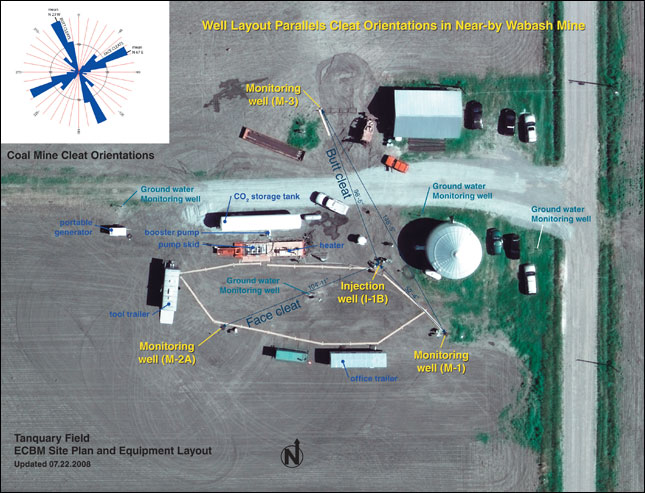
- Single-well injection and multi-well monitoring project, 1 face-cleat and 2 butt-cleat monitoring wells
- Coal cores taken for extensive characterization analyses because coal maceral composition influences CO2 adsorption; shallow resistivity logs suggest greater fracturing in the more vitrinitic intervals, thus potentially providing preferential pathways for CO2 injection
Water injection pressure transient tests, injected water pre- and post-CO2 to estimate pre- and post-injection permeability
- Multiple CO2 Injection Tests - Injection/shut-in pulses of CO2 until methane breakthrough in butt cleat direction, CO2 breakthrough in low permeability (butt cleat) direction first; CO2 and methane breakthrough in high permeability (face cleat) direction after producing small amount of water
- All injection above methane desorption pressure from Langmuir isotherm
 Project status:
CO2 injection results:
Project status:
CO2 injection results:
- Completed 102 tons cumulative injection
- 1.02 tons/day injection rate
Results:
- Direct pilot measurements:
- CO2 desorbed methane in situ; methane and CO2 moved more readily in butt cleat direction compared to face cleat direction
- No reduction in injection rate attributable to CO2 swelling observed; no CO2 detected out of the injection zone
- Fullfield projections:
- Potential CH4 recovery up to 70%
Monitoring, verification, and accounting:
- Conducted baseline, injection, and post-injection monitoring including, continuous in-zone pressure and temperature, gas content of the injection formation, cased-hole logging, shallow groundwater quality, and shallow geophysical surveys
- Conducted reservoir, geochemical, and groundwater flow modeling to verify operational and field efforts
- Acquired high-resolution, color-infrared aerial imagery to assess potential stress; no CO2 stress identified
- Continued to monitor groundwater quality through January 2010, one year after CO2 injection terminated
- Finalized geochemical evaluation and modeling of groundwater quality data
Preliminary MVA results:
- Shallow groundwater quality has not been impacted by CO2 injection activities, based on water chemistry results
- Acquired high-resolution, color-infrared aerial imagery to assess potential stress; no CO2 stress identified
- Hydrogeologic flow model developed that shows groundwater flow is generally from the west